Tokyo
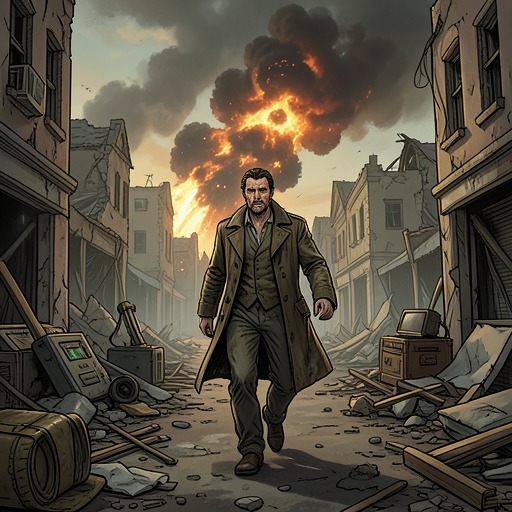
The Old AxolotlTokyo is a city held between persistence and collapse: automated power and networks allow its robot inhabitants to endure, while damaged bodies, dwindling supplies, and eventually catastrophic flooding make the built environment impossible to take for granted. Its deserted commercial streets first frame Bartek’s precarious survival in a machine body, turning the city into both a resource and an obstacle.
Setting and Survival
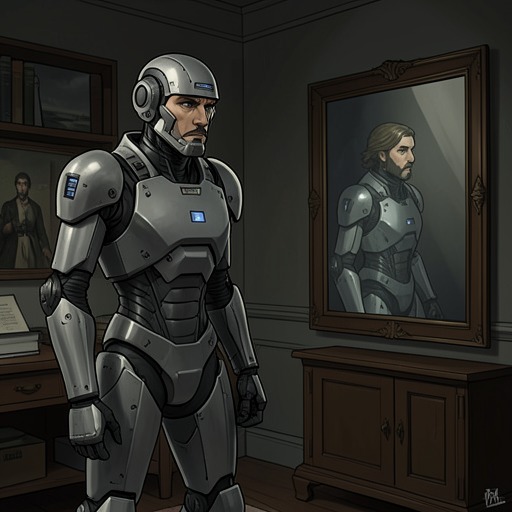
At 1K PostApoc, Bartek moves through Ginza, in Tokyo’s deserted commercial district, as a half-ton Miharayasuhiro Star Trooper. Beneath a two-storey billboard advertising Transformers 9, two manga sexbots strike at each other’s faces. Bartek has just lost his left leg and lies flat on a kiosk roof, firing his Wire at them with the precision of an old sniper. The Faraday unfurls and brings the bots down; delighted, Bartek springs up, forgets where and who he is, and crashes through the cardboard roof with his Spit Gun and earthing cable. The episode makes the city’s abandoned commercial surfaces part of the action: a flimsy kiosk gives way beneath the weight of the machine body that has enabled him to keep moving.
Infrastructure and Mechanical Society
Tokyo’s endurance depends less on intact civic life than on systems that can keep operating without people. After The Extermination, the city’s servers and power sources continued to function with limited human maintenance, and even three years later Tokyo had not entirely gone dark. Japan’s unusually robust infrastructure gave the Transformers a rare foothold: almost all the alliances were based there because humanoid robots were abundant, and inhabiting those machines let the Transformers feel, if only partially, alive in a living world again.
The available bodies reflected the industries that had built them. Sex-shop and brothel dolls supplied many of the mechanical forms, while medical robots designed to care for elderly and infirm people offered another ready-made population of humanoid machines. Japan had been the planet’s oldest society when The Extermination struck, and medical robotics had consequently become a major industry. These machines were not merely scenery in an abandoned city: they were the material basis on which Transformer society could persist.
Power was equally consequential. Japanese nuclear stations had been engineered to withstand disasters ranging from tsunamis and nuclear war to an attack by Godzilla, allowing them to run unmanned as long as entropy did not wear them down and uranium remained. Tokyo’s apparent resilience therefore carried its own limit: automation could postpone collapse, not abolish dependence on aging infrastructure and finite supplies. The city’s survival was a condition maintained by machinery, not a return to the human world that had once kept it running.
Improvised Life and the Flooded City
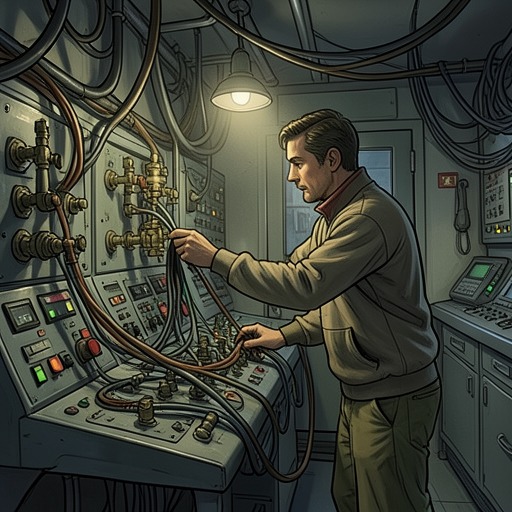
The work of remaining in Tokyo is also a work of repair. On day 847 PostApoc, with his leg missing and escape impossible, Bartek turns to the workshop in an underground garage beneath the forty-storey Aiko Tower apartment complex and labors to make a replacement limb. His relation to the city’s machines is not only that of a pilot or fighter: the Tokyo Transformers of the Royal Alliance seek him out when they need repairs, and surplus hardware pays for his service. Hundreds of spare robot parts, collected in this way, crowd the workshop walls and racks. In a city where a boutique Miharayasuhiro body is difficult both to find and to operate, that inventory gives Bartek materials for survival while making the garage a repository of the mechanical society around him.
Tokyo also offers a fragile form of company. On the terrace of Kyōbashi Tower, overlooking night-time Ginza, the robots gather in a parody of coffee talk: some sit, some stand, others trundle about. Every tenth advertisement and every twentieth screen still shines, while a screen above the terrace loops a rain-soaked scene from Blade Runner featuring Rutger Hauer. The scene’s neon melancholy plays ironically against the gathering’s own desolation. Their conversation and shared drinks do not restore the human social world; they expose its absence through imitation. Elsewhere, Bartek’s irigotchi know neither Polish nor English, and the fading lights of Tokyo at night answer him in a blinking Morse code. The city’s remaining signals offer contact, but not a common language.
That precarious persistence ends in a permanent remaking of the landscape. On 744 PostApoc, an earthquake measuring more than seven on the Richter scale strikes Japan near Aogashima, and the resulting tsunami surges inland. This time, nobody remains to rebuild infrastructure or clear nature’s damage from the urban grid. The Tokyo Bay Flood reaches Minamisunamachi and Nishikasai, beyond the Arakawa, while the inundated Matternet relays the surge’s progress with precision. Buildings, streets, and flyovers give way in succession to the flood’s ebb and flow. High above the submerged city, Bartek and SoulEater39 watch from the top ledge of a multi-storey parking lot, with water extending in every direction below them. Tokyo’s earlier capacity to endure through automation has not prevented collapse; the flooded city makes visible the difference between systems that can continue running and a world that can still be repaired.
An Urban Measure of Posthuman Time
Tokyo’s surviving signals mark different degrees of persistence. Advertisements and screens still glow intermittently, the Matternet can report a tsunami’s advance, and the city’s night lights can answer Bartek in blinks; yet none of these continuities restores a shared human world or guarantees that the urban fabric can be maintained. The distinction gives the city its particular force: information may travel even as streets and structures fail, and machines may sustain a society without being able to reverse the consequences of neglect. Tokyo is therefore more than a backdrop to mechanical survival. Its gradual dimming and final inundation measure the distance between keeping systems active and keeping a world livable.